
Articles
Rethinking Daily Focus: Frog Breakfast
Most people do not abandon task management apps because they lack discipline. They abandon them because the software is not designed to to handle real-life scenarios.
When unfinished tasks roll over automatically from Tuesday into Wednesday, then into Thursday, your to-do list stops being helpful as a planning tool. It becomes a permanent record of everything you didn’t do — a depressing way to start your day. Just a few days of a hectic schedule and your app is full of guilt.
And a few weeks? Opening the app triggers the exact same dread as opening a credit card statement. At first you try to overcome this. You sort by urgency, add colored tags, adjust priority levels, and rearrange cards—a process that feels like productivity, but is actually just managing overhead. You have to work just to feel like you can work.
If you want to protect your focus and end the day with a clear head, you have to fix the system underlying your daily rhythm.
The Three Silent Drivers of Task Avoidance
To fix how you work, it helps to understand why traditional task systems fail when work gets complex.
1. Unfinished Tasks Drain Your Focus
When you leave work at night with half-finished items hanging over your head, your brain doesn’t just forget about them. They sit in active memory, quietly generating background noise while you try to relax, eat dinner, or sleep. When an app lists thirty unfinished items from yesterday, you start the day mentally tired before you even begin.
2. The Fallacy of Continuous Inheritance
Standard tools assume tomorrow is simply an extension of today. They inherit yesterday’s leftovers by default. But yesterday’s plan was made under different constraints and with different information. Inheriting an overcrowded list forces you to start every morning in a reactive state, triaging past delays before you even choose today’s priorities. The solution? Close your day. End the day celebrating what you got done. Move the items you didn’t get done to a realistic plan.
3. Avoiding “The Frog”
When a task is difficult, vague, or uncomfortable, we naturally defer it. The problem is that deferred tasks rarely disappear; they sit at the top of your list, quietly draining your momentum. Inexplicably, they get harder to do the longer they sit. The guilt becomes a reason to avoid them in the first place. You complete five low-value administrative items just to feel productive, while the single task that actually moves your work forward gets pushed to “tomorrow” again. The solution? Eat the frog — the hardest task — first, so you can move forward guilt free.
A 4-Step Framework for Resetting Your Daily Execution
Reclaiming your focus doesn’t require a complex multi-tiered setup. It requires strict operational boundaries between planning, executing, and closing your day.
Step 1: Decide Today’s Scope (Do Not Inherit It)
Stop letting your backlog dictate your morning. Treat today as a clean canvas. Pull forward only what you are explicitly committing to complete today. Everything else remains safely in your master backlog, out of sight and out of mind.
Step 2: Identify and Isolate “The Frog”
Identify the single task you are most likely to avoid—the one requiring deep focus or uncomfortable decision-making. Define the immediate next physical action needed to start it. Do not check non-critical email or open communication channels until that single primary objective is tackled.
Step 3: Run Fixed Daily Rituals
Create rigid entry and exit points for your workday:
- Morning Alignment: Spend two minutes reviewing today’s scope and isolating your core priority.
- Evening Closure: Spend two minutes clearing the slate. Mark completed work, explicitly move unfinished tasks back to the backlog or a future date, and shut down the system so work stops following you home.
Step 4: Treat Interruption as Data, Not Failure
Plans break. Priorities shift. When you fail to complete a planned task, resist the urge to view it as a personal fault. Treat it as diagnostic data: Was the task defined too broadly? Was the scope unrealistic? Did an unexpected dependency emerge? Adjust the next attempt based on what actually happened, not what you wished happened.
How Frog Breakfast Built a System Around the Reset
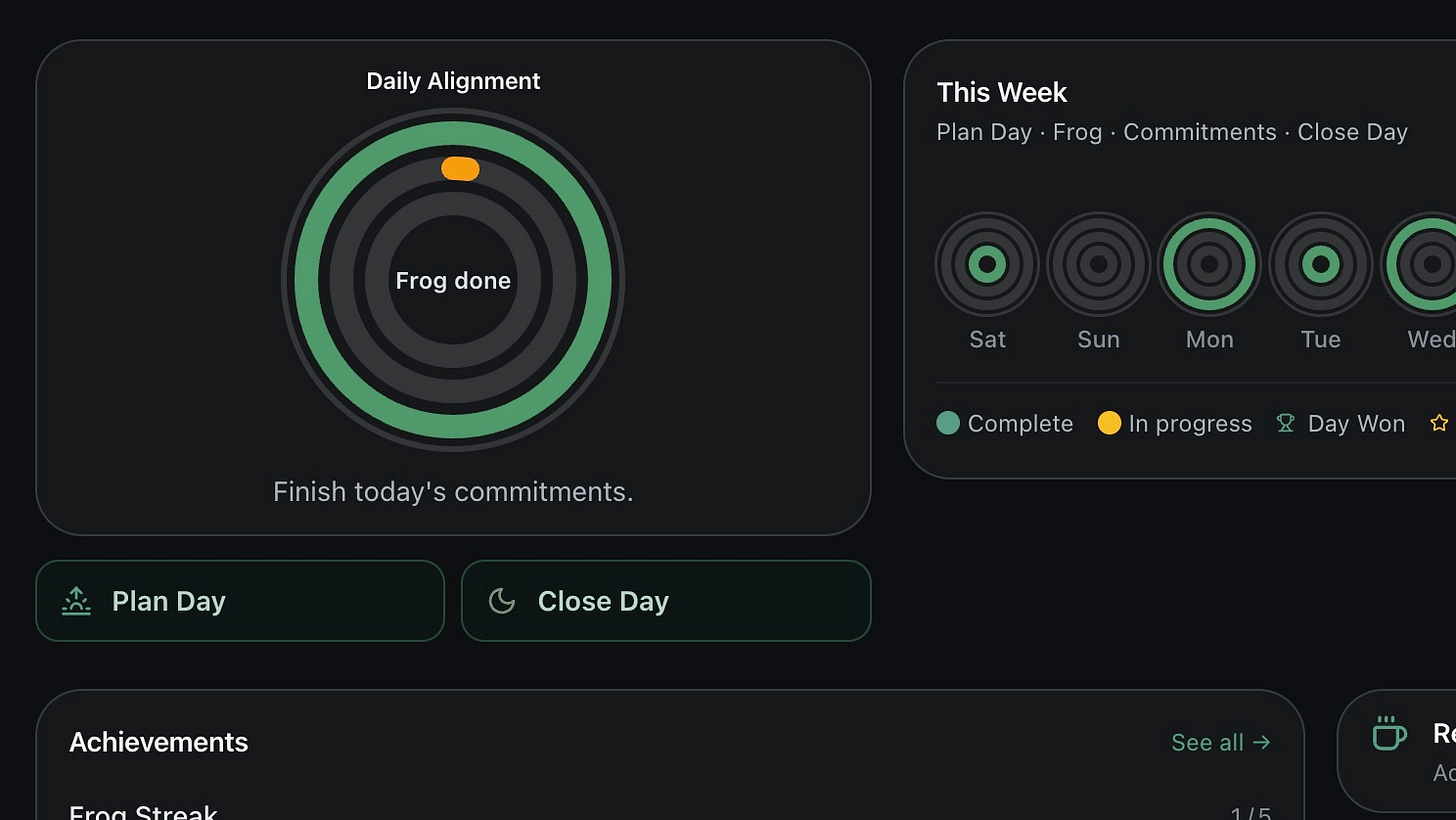
We built Frog Breakfast (frogbreakfast.com) specifically to enforce this reset-driven rhythm, replacing endless backlog accumulation with behavioral structure.
- Automatic Frog Detection: Rather than relying on guesswork, the app monitors postponement patterns and untouched items to flag the specific task you are most prone to pushing aside.
- Guided Rituals: Built-in “Plan My Day” and “End of Day” workflows guide you through setting daily scope and wrapping up your work, ensuring you end the evening with peace of mind instead of an overdue list.
- Zero-Guilt Resets: The system is engineered for real life. If your day gets derailed, there are no red “overdue” warnings or broken streak penalties. You simply reset, adjust, and start fresh tomorrow.
If you are ready to stop managing task debt and start ending your day with a clean slate, try the daily reset approach at frogbreakfast.com.
Found this useful? Subscribe to get new articles in your inbox.